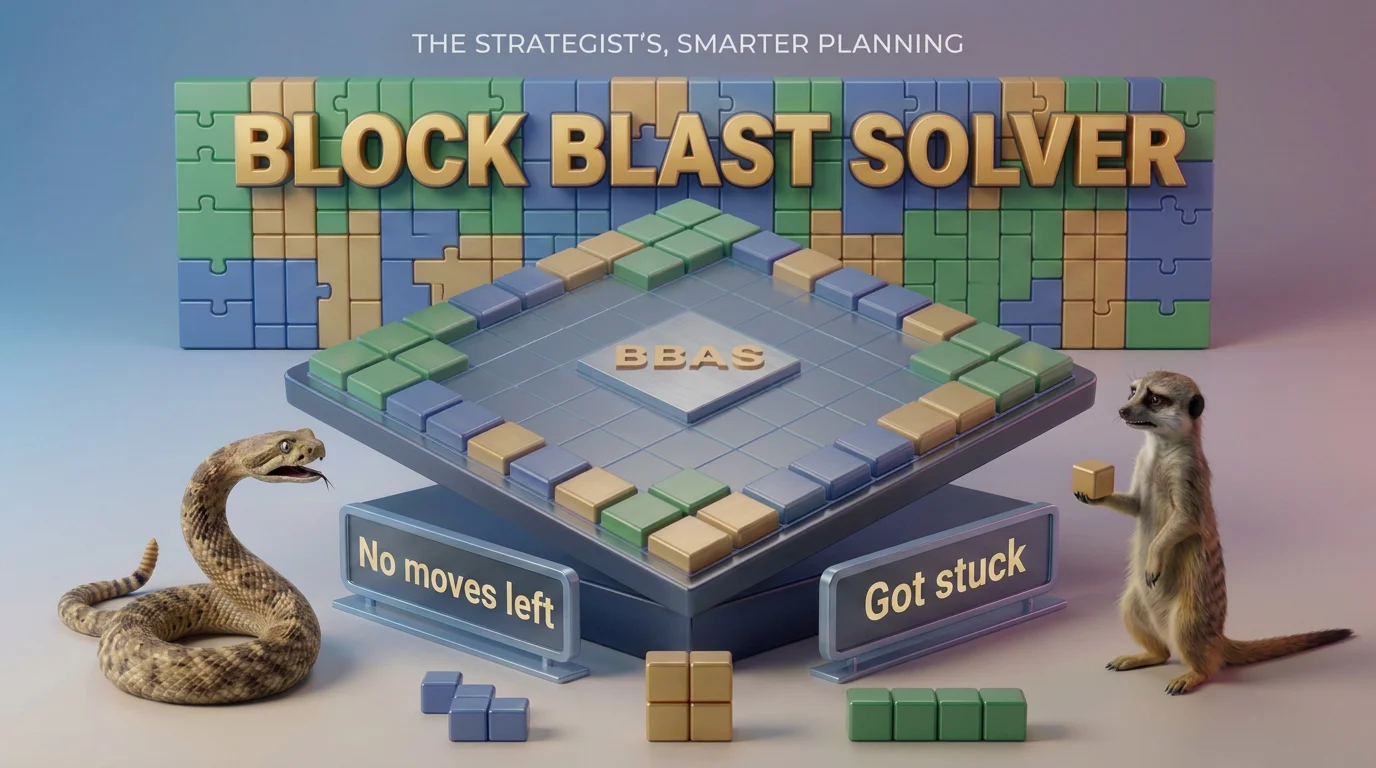
No Moves Left in Block Blast? Here's Exactly What to Do

    Got stuck in Block Blast

    That moment when you stare at a full board and no shape fits is frustrating but avoidable. Most players hit a dead board not because they ran out of luck, but because a few placement decisions earlier in the game backed them into a corner. Understanding why moves disappear is the first real step, and a Block Blast Solver can make that visible in seconds.

    This guide breaks down exactly what causes no-moves situations, how to spot when your board is heading toward one, and the specific strategies you can use to keep options open without restarting every few rounds.

    Why You End Up With No Moves Left

    A no-moves situation almost always starts several turns before it actually hits. The board fills up in a fragmented way, with scattered gaps, blocked shapes with no room to land, and no vertical channel left to accept a tall piece.

    The Three Most Common Causes

    Players usually blame the pieces they are given, but the board state that leads to no moves is almost always self-inflicted. Each cause below quietly reduces future placement options before the board actually locks up.

    Ignoring placement order

    Placing pieces wherever they fit without thinking about line clearance creates isolated pockets the board can never recover from.

    Filling the center first

    Central flexibility is everything. Once the middle is blocked, large pieces like a 3x3 square have nowhere to go.

    Not thinking ahead

    Every shape you place affects where the next two or three land. Move sequencing matters more than single-turn optimization.

    How to Read a Board Before It Dies

    A dead board rarely happens without warning. Watch for these signals. Once two or more appear at the same time, your next priority is clearance, not placement.

    No open column for a vertical 3-block

    If every column has at least one filled cell blocking a three-high drop, tall pieces are already stranded.

    No 3x3 open area for a square piece

    A 3x3 square needs nine contiguous open cells. When that area disappears, one of the most common pieces becomes unplaceable.

    A T-shape has no legal landing spot

    T-shapes need a specific open pattern. When no row or column can accept one, the board is already critically fragmented.

    All gaps are isolated single cells

    Lone empty cells surrounded by filled squares cannot be reached by any piece. Every orphaned cell is permanent wasted space.

    Block Blast Gameplay Screenshot

    Strategies to Avoid Getting Stuck

    These four habits separate players who consistently survive crowded boards from those who keep restarting. Each one targets a specific decision point that usually goes wrong.

    1. Prioritize Line Clearance Over Position

    Before placing any piece, ask whether that placement completes a row or column. Clearing a line opens breathing room for the next piece. A placement that looks spatially tidy but clears nothing often makes the board worse two turns later.

    Clear first, optimize second

    A line clear that looks suboptimal still gives you back full rows and columns that future pieces can use cleanly.

    Not every neat placement is correct

    Pieces that fit snugly but do not clear anything quietly reduce future options, even when they look fine in the moment.

    2. Keep at Least One Vertical Channel Open

    A single clear column gives you a permanent fallback for vertical 3-block pieces and L-shapes. Leaving one vertical channel open costs you one cell but saves several future moves.

    Protect one column as a dedicated drop lane

    Treat it as a reserved zone. Only fill it when a line clear is guaranteed from doing so.

    3. Think in Groups of Three

    You always see your next three pieces at once. Before placing the first one, look at how all three can land together. Move sequencing often makes the difference between a clean line and a blocked board.

    Place the hardest-to-fit piece first

    Identify which of the three shapes is most restrictive, then secure its landing zone before the others take that space.

    Placing the easiest piece first is a common trap

    It feels productive but often closes off the only spot the most awkward piece could have used.

    4. Never Orphan Cells

    An orphaned cell is a single open square surrounded by filled ones. No piece can ever reach it. Once a board has three or four orphaned cells, the effective board size shrinks permanently.

    Creating isolated single-cell gaps

    Lone empty cells with no realistic fill path are permanent damage to your board budget.

    Keep empty cells connected whenever possible

    Five connected empty cells are more useful than five isolated gaps scattered across the board.

    What to Do When No Shape Fits Right Now

    If you are already in a near-dead board state, switch out of normal play mode immediately. The goal at this point is not scoring. It is surviving one more turn so the board can partially reset. Follow the triage steps in order.

    If none of these steps reveal a legal placement, the board is genuinely dead. But more often than not, at least one piece has a legal spot — it just requires looking at the board differently than you were.

    Triage steps in order:

    1. Scan for any partial line

    Even one cell missing from a row can be the key. Fill it first if a current piece allows — clearing that row opens room everything else needs.

    2. Use the smallest piece available

    A 1x1 or 1x2 can clear the one gap that unlocks a full row, opening room for bigger shapes that seemed impossible a moment ago.

    3. Sacrifice a bad position if needed

    If one placement makes zero lines but prevents a worse outcome, it may still be the best move available. Sometimes survival is the only goal.

    Use a Block Blast Solver to Spot Moves You Are Missing

    One of the fastest ways to avoid dead boards is to study the placement decisions you are getting wrong in real time. A Block Blast Solver lets you upload a screenshot of your current board and see the optimal placement sequence for the shapes in hand. Not just the best single move, but the full sequence that protects the most future board flexibility.

    If you want to apply these same habits toward high-score strategies, the board-reading skills covered here directly transfer.

    This is especially useful when you are already in a tight spot and cannot see a clean way forward. Instead of guessing, you see exactly what the strongest play looks like. Over time, studying these solutions builds the forward-thinking habit that prevents dead boards before they start.

    Upload your board when you are one or two moves from stuck

    The solver returns the full placement sequence, not just the next move, so you can see how the next three turns should unfold.

    Use it to study, not just to survive

    Reviewing the suggested sequence after a run builds the same forward-thinking habit manually over time.

    Solution by Solver

    Board Getting Tight? Check Your Next Move Now

    Upload a screenshot of your current board or enter your shapes manually and let the Block Blast AI Solver show you the strongest placement sequence before your next move closes off your last option.

    Try Block Blast Solver Now

    Frequently Asked Questions