Block Blast Hard Levels
Last updated:
Players use "Block Blast hard levels" to mean two different things. Some mean a tough level in Adventure Mode. Others mean a Classic run where the board has filled up and every set of pieces feels like a trap. The skills that get you through both are the same, because the board works the same way in each: an 8x8 grid, three pieces at a time, and no way to rotate them.
This guide shows one hard board worked through step by step, then the four situations that cause the most trouble. If you want a second opinion on your own board, the free Block Blast Solver reads it from a screenshot and suggests a placement.
Why Do Block Blast Hard Levels Feel So Difficult?
A tough board is rarely full. What makes it hard is how little room it leaves to recover. On an open board, an awkward placement costs you very little because there is space somewhere else. On a packed one, the same placement can decide the whole run.
Blocks in Block Blast do not fall or settle after a clear, so a gap you leave behind stays exactly where it is until you fill it or clear its row or column. Small mistakes stay on the board and add up. When none of your pieces fits anywhere, our guide to what happens when there are no moves left in Block Blast explains how a board gets there.
A Worked Example: The Piece With the Fewest Spots
The general rule, covered in our Block Blast strategy guide, is to place the piece with the fewest possible spots first. Here is what that looks like on a busy board.
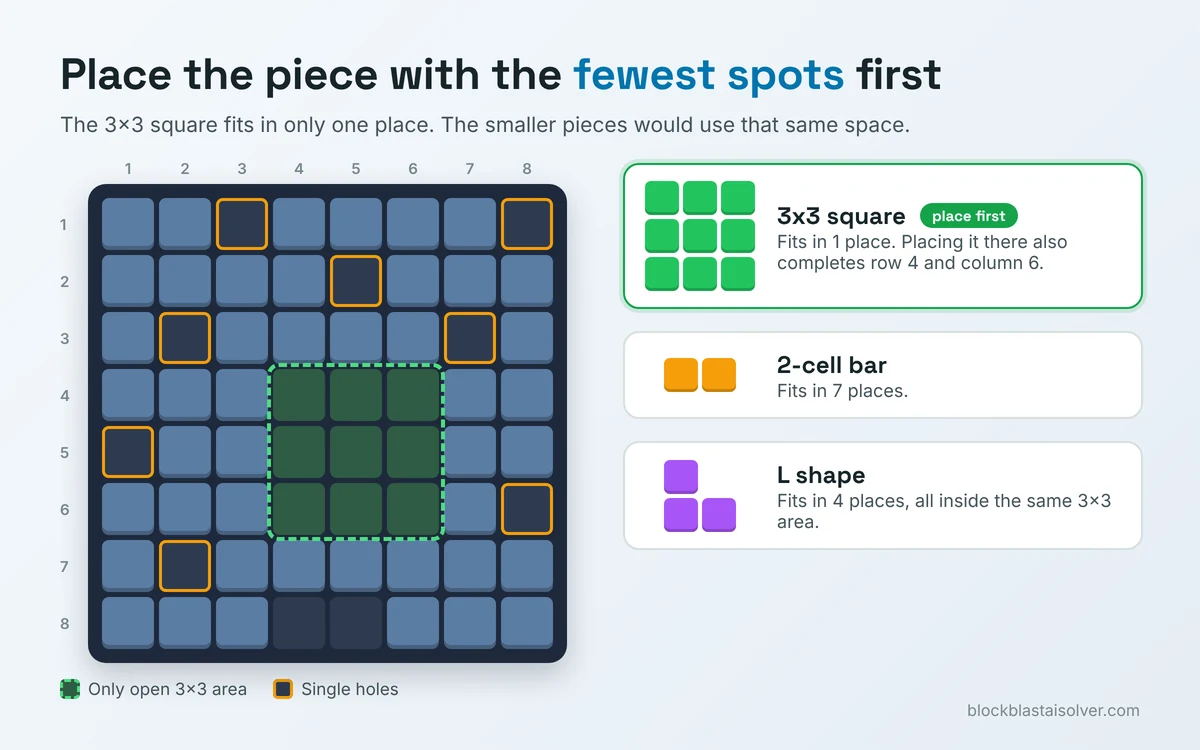
On this board you hold a 3x3 square, a 2-cell bar and an L shape. The square fits in only one place: the open area in rows 4 to 6 and columns 4 to 6. The bar fits in 7 places and the L in 4, but every spot for the L, and most spots for the bar, sit inside that same area. Put either small piece into that area first and the square has nowhere left to go.
Place the square first instead, and it also completes row 4 and column 6. Both clear, and the bar and the L still have room afterwards.
There is one exception to the rule. If a small piece would complete a row or column, and that clear opens room for the large piece, place the small piece first. The goal is the same either way: the order that lets all three pieces fit.
Four Hard Board Situations and What to Do
The 3x3 Square Has Nowhere to Go
The 3x3 square needs nine connected empty cells. On a busy board that is often the rarest shape there is. If you are holding one, find every 3x3 area that is still fully open before you move anything else. If there is only one, place the square there first. If there are none, look for a clear that would open one up, and use your other pieces to make that clear happen.
A Long Straight Piece Shows Up
A long straight piece needs a full open lane in one direction. Check every row and column that is almost empty, including the ones along the edges of the board. If a lane is close to complete, a straight piece can also be the piece that finishes a row or column and frees up space.
The Middle of the Board Is Filling Up
A large piece needs open room in more than one direction. A cell in an open middle has space on every side, while a cell on an edge or in a corner has space on fewer sides, so big pieces have more ways to fit in an open middle. When the middle fills up, the board becomes a ring of narrow edges, and big pieces run out of places quickly. If you have a choice, use the edges and corners for small pieces and try to keep a broad area in the middle open.
All Three Pieces Are Large
Sometimes all three pieces are big at once. You have to place all three before new ones arrive, so the order matters more than ever. Work out whether placing one of them completes a line, because that clear might open the room the next one needs. If no order fits all three, choose the order that places the most pieces and leaves the board in the best shape.
Frequently Asked Questions
How do I beat challenging Block Blast Levels?
Look for the most restricted piece, protect one useful open area, and compare the board after each possible placement.
Why do hard Boards feel impossible?
They leave less room for recovery, so small placement mistakes have a bigger effect on later moves.
Should I use a Solver on a hard Level?
A solver can be useful for studying a difficult position or checking whether a legal sequence exists.
What is the first Thing to do on a crowded Board?
Check whether any row or column is one or two cells from complete. On a crowded board a clear is often the only way to make room, so knowing where one is possible tells you which of your pieces can open the board back up.
Can a difficult Board still be saved?
Often, if you act before the last open area is gone. A board is usually saved by a clear that opens room for your largest piece, so look for a row or column you can finish with the pieces you are holding.
Stuck on a Board? Get the Best Move Instantly
Upload a screenshot or fill the grid manually. Our AI Block Blast Solver suggests a placement in seconds, free and with no sign-up.
Try Solver Now